

ABOUT CONFERENCE
The 4th International Conference on Material Science and Technology will take place on July 05–06, 2027, in Dubai, UAE, under the theme “Innovation at the Intersection of Science and Materials.”The conference brings together researchers, scientists, engineers, academicians, industry professionals, technology developers, and emerging researchers to explore the latest advancements in materials science and technology. It provides a global platform for sharing innovative research, discussing emerging technologies, and developing collaborations across academia and industry.
WHY ATTEND ?
- Explore the latest breakthroughs in material science and engineering.
- Discover emerging technologies and next-generation materials.
- Present your research to an international scientific audience.
- Connect with researchers, academics, engineers, and industry experts.
- Exchange ideas and develop international collaborations.
- Learn about sustainable and advanced material solutions.
- Gain insights into future trends and industrial applications.
- Expand your professional and research network.
WHO SHOULD ATTEND
- The conference welcomes:
- Material Scientists and Researchers
- Chemical and Mechanical Engineers
- Nanotechnology Researchers
- Polymer and Composite Specialists
- Metallurgists and Ceramic Scientists
- Biomedical and Biomaterials Researchers
- Academicians and Professors
- Research Scholars and Students
- Industry Professionals and R&D Teams
- Technology Developers and Innovators
- Manufacturing and Engineering Professionals
- Entrepreneurs and Startups
- Government and Research Organizations
KEY HIGHLIGHTS
🌐 Global Scientific Platform
Connect with an international community of researchers, scientists, engineers, and technology professionals.
🔬 Cutting-Edge Research
Explore new discoveries and innovative approaches across material science and technology.
💡 Innovation & Technology
Discover advancements in smart materials, nanomaterials, composites, biomaterials, sustainable materials, and advanced manufacturing.
🤝 Networking & Collaboration
Build meaningful connections with academic institutions, research organizations, and industry leaders.
🎤 Expert Presentations
Gain valuable perspectives through keynote lectures, invited talks, oral presentations, and scientific discussions.
🏭 Academia–Industry Interaction
Explore opportunities for collaboration between scientific research and real-world industrial applications.
MODE OF PARTICIPATION
- In-Person Participation And Oral Presentation
- Poster Presentation
- Virtual Participation
- Student Participation ,Delegate Participation ,Industry Participation ,Exhibition Participation Workshop Participatio ,Keynote Speaker
VISA ASSISTANCE
-
Longdom provides visa assistance to international participants by issuing official invitation letters and required conference documents upon successful registration.
- Participants are responsible for applying for their visa independently and fulfilling all requirements of the relevant embassy or consulate.The conference team provides necessary conference-related information and documentation to support participants throughout the visa application process.
- Visa approval is subject to the decision of the respective immigration authorities, and Longdom cannot guarantee visa issuance.
TRACKS AND SESSIONS
Track 1: Advanced Materials and Functional Materials
Advanced materials are driving innovation across engineering, electronics, healthcare, energy, and industrial applications. This track explores high-performance, multifunctional, and application-specific materials designed to meet emerging technological demands.
Keywords: Advanced Materials, Functional Materials, High-Performance Materials, Material Design, Material Innovation, Multifunctional Materials.
Track 2: Nanomaterials and Nanotechnology
This track focuses on materials engineered at the nanoscale and their unique physical, chemical, and mechanical properties. It covers synthesis, characterization, nanocomposites, and applications across healthcare, electronics, energy, and environmental technologies.
Keywords: Nanomaterials, Nanotechnology, Nanostructures, Nanocomposites, Nanoengineering, Nanofabrication.
Track 3: Smart and Intelligent Materials
Smart materials respond to changes in temperature, pressure, electric fields, magnetic fields, or other environmental stimuli. This track highlights their development and applications in engineering, robotics, aerospace, healthcare, and advanced technologies.
Keywords: Smart Materials, Intelligent Materials, Shape Memory Alloys, Piezoelectric Materials, Responsive Materials, Self-Healing Materials.
Track 4: Composite and Hybrid Materials
Composite materials combine two or more components to achieve enhanced mechanical, thermal, or functional properties. This track explores advanced composites for lightweight structures, transportation, construction, aerospace, and industrial applications.
Keywords: Composite Materials, Hybrid Composites, Polymer Composites, Fiber-Reinforced Materials, Carbon Fiber, Reinforced Materials.
Track 5: Biomaterials and Biomedical Materials
Biomaterials play an important role in medical devices, implants, tissue engineering, and regenerative medicine. This track examines biocompatibility, material–tissue interactions, biomedical coatings, and next-generation healthcare materials.
Keywords: Biomaterials, Biomedical Materials, Biocompatibility, Medical Implants, Tissue Engineering, Regenerative Materials.
Track 6: Polymer Science and Engineering
This track covers the design, synthesis, processing, characterization, and applications of polymers and advanced polymeric materials. Emphasis is placed on high-performance polymers, sustainable polymers, and polymer-based technologies.
Keywords: Polymer Science, Polymer Engineering, Biopolymers, Polymer Nanocomposites, Polymer Processing, High-Performance Polymers.
Track 7: Metals, Alloys and Metallurgical Engineering
This track explores the development, processing, characterization, and performance of metals and advanced alloys. It addresses innovations in metallurgy for structural, automotive, aerospace, energy, and industrial applications.
Keywords: Metals, Alloys, Metallurgy, Steel, Alloy Development, Metal Processing, Structural Materials.
Track 8: Ceramics, Glass and Refractory Materials
Advanced ceramics and glass materials offer exceptional thermal, chemical, electrical, and mechanical properties. This track discusses innovative processing methods and applications in electronics, energy, construction, healthcare, and high-temperature environments.
Keywords: Advanced Ceramics, Glass Materials, Refractory Materials, Ceramic Processing, Technical Ceramics, Ceramic Composites.
Track 9: Sustainable and Green Materials
Sustainable materials are essential for reducing environmental impact and supporting a circular economy. This track explores renewable, recyclable, biodegradable, and low-carbon materials for future industrial and technological applications.
Keywords: Sustainable Materials, Green Materials, Recyclable Materials, Biodegradable Materials, Circular Economy, Eco-Friendly Materials.
Track 10: Energy Storage and Energy Materials
Energy materials support the development of efficient batteries, fuel cells, solar technologies, and other energy systems. This track focuses on advanced materials for energy generation, storage, conversion, and sustainable energy technologies.
Keywords: Energy Materials, Battery Materials, Fuel Cells, Solar Materials, Energy Storage, Energy Conversion.
Track 11: Electronic, Semiconductor and Photonic Materials
This track focuses on materials used in electronic devices, semiconductors, sensors, photonic systems, and next-generation technologies. It explores material properties, device integration, thin films, and advanced electronic applications.
Keywords: Semiconductor Materials, Electronic Materials, Photonic Materials, Thin Films, Sensors, Microelectronics.
Track 12: Additive Manufacturing and 3D Printing Materials
Additive manufacturing is transforming the production of complex components and customized structures. This track examines advanced printing materials, processing technologies, material optimization, and applications of 3D printing across industries.
Keywords: Additive Manufacturing, 3D Printing, Printing Materials, Digital Manufacturing, Powder Processing, Advanced Fabrication.
Track 13: Materials Characterization and Analytical Techniques
Understanding material structure and properties is essential for developing high-performance materials. This track covers modern analytical and characterization techniques used to investigate composition, morphology, mechanical properties, and material behavior.
Keywords: Materials Characterization, Microscopy, Spectroscopy, X-Ray Diffraction, Mechanical Testing, Material Analysis.
Track 14: Surface Engineering, Coatings and Corrosion
Surface engineering improves the durability, functionality, and performance of materials under demanding conditions. This track explores protective coatings, surface modification, wear resistance, corrosion control, and advanced thin-film technologies.
Keywords: Surface Engineering, Protective Coatings, Corrosion, Thin Films, Surface Modification, Wear Resistance.
Track 15: Materials Processing and Manufacturing Technologies
Modern processing technologies play a major role in controlling material properties and manufacturing performance. This track covers casting, forming, machining, heat treatment, sintering, welding, and other advanced processing methods.
Keywords: Materials Processing, Manufacturing, Casting, Forming, Heat Treatment, Machining, Welding.
Track 16: Computational Materials Science and Materials Informatics
Computational approaches and artificial intelligence are accelerating materials discovery and development. This track explores modeling, simulation, machine learning, data-driven materials design, and computational prediction of material properties.
Keywords: Computational Materials Science, Materials Modeling, Simulation, Machine Learning, Materials Informatics, AI in Materials Science.
Track 17: Aerospace, Automotive and Structural Materials
Advanced materials are essential for developing lightweight, durable, and high-performance transportation systems. This track explores materials designed for aerospace, automotive, infrastructure, and other demanding structural applications.
Keywords: Aerospace Materials, Automotive Materials, Lightweight Materials, Structural Materials, High-Temperature Materials, High-Strength Materials.
Track 18: Construction and Infrastructure Materials
Innovative construction materials contribute to stronger, more durable, and sustainable infrastructure. This track covers advanced concrete, cement, composites, smart construction materials, and technologies for modern infrastructure development.
Keywords: Construction Materials, Cement, Concrete, Structural Materials, Infrastructure Materials, Sustainable Construction.
Track 19: Environmental Materials and Waste Management
Materials science offers innovative solutions for environmental protection, pollution control, water treatment, and resource recovery. This track focuses on functional materials designed to address environmental challenges and promote sustainable technologies.
Keywords: Environmental Materials, Water Treatment, Adsorbent Materials, Waste Management, Pollution Control, Resource Recovery.
Track 20: Emerging Materials, Innovations and Future Technologies
This track highlights emerging discoveries and interdisciplinary innovations that are shaping the future of material science and technology. It provides a platform for discussing next-generation materials, breakthrough technologies, and future research directions.
Keywords: Emerging Materials, Future Materials, Material Innovation, Next-Generation Technologies, Interdisciplinary Research, Future Trends.
MARKET ANALYSIS
The global smart materials market size was valued at USD 72.4 billion in 2023 and is projected to grow from USD 100.1 billion in 2026 to USD 133.1 billion by 2030, at a CAGR of 8.0% from 2024 to 2030. North America dominated the market, accounting for a revenue share of 38.2% in 2023. Smart materials exhibit responsiveness in a controlled manner to changing environments.
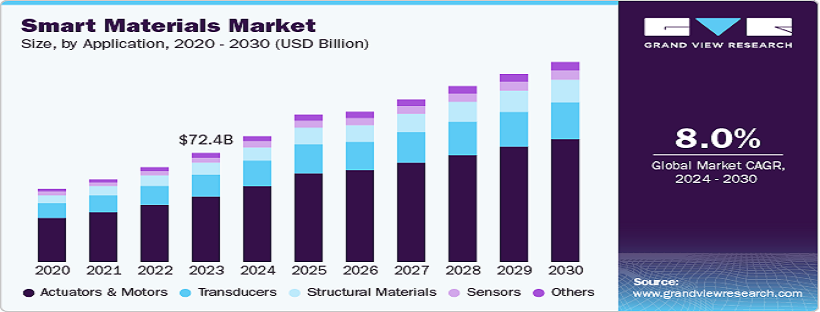
Key Market Trends & Insights
- The U.S. smart materials market dominated the North America market with a share of 77.7% in 2023 due to advancements in material science.
- Based on product, the piezoelectric materials segment dominated the market and accounted for a share in 2023.
- In terms of application, the actuators & motors segment accounted for the largest market share of 60.4% in 2023.
- On the basis of application, the structural materials segment is expected to register the fastest CAGR of 8.4% during the forecast period.
Market Size & Forecast
- 2023 Market Size: USD 72.4 billion
- 2030 Projected Market Size: USD 133.1 billion
- CAGR (2024-2030): 8.0%
- North America: Largest market in 2023
They have a molecular structure, which allows them to respond to a wide array of external stimuli, such as magnetic fields, electric fields, pressure, moisture, temperature, and chemicals. Rising demand for sensors and actuators in aerospace & defense, consumer electronics, and consumer goods have propelled the demand.
PAST CONFERENCES
The 1st, 2nd, and 3rd editions of the Material Science and Technology conference created a global platform for researchers, scientists, academicians, engineers, and industry professionals to exchange knowledge and present innovative research.Building on the success of these editions, the 4th International Conference on Material Science and Technology, taking place on July 05–06, 2027, in Dubai, UAE, continues this scientific journey with a focus on “Innovation at the Intersection of Science and Materials.”